Biography
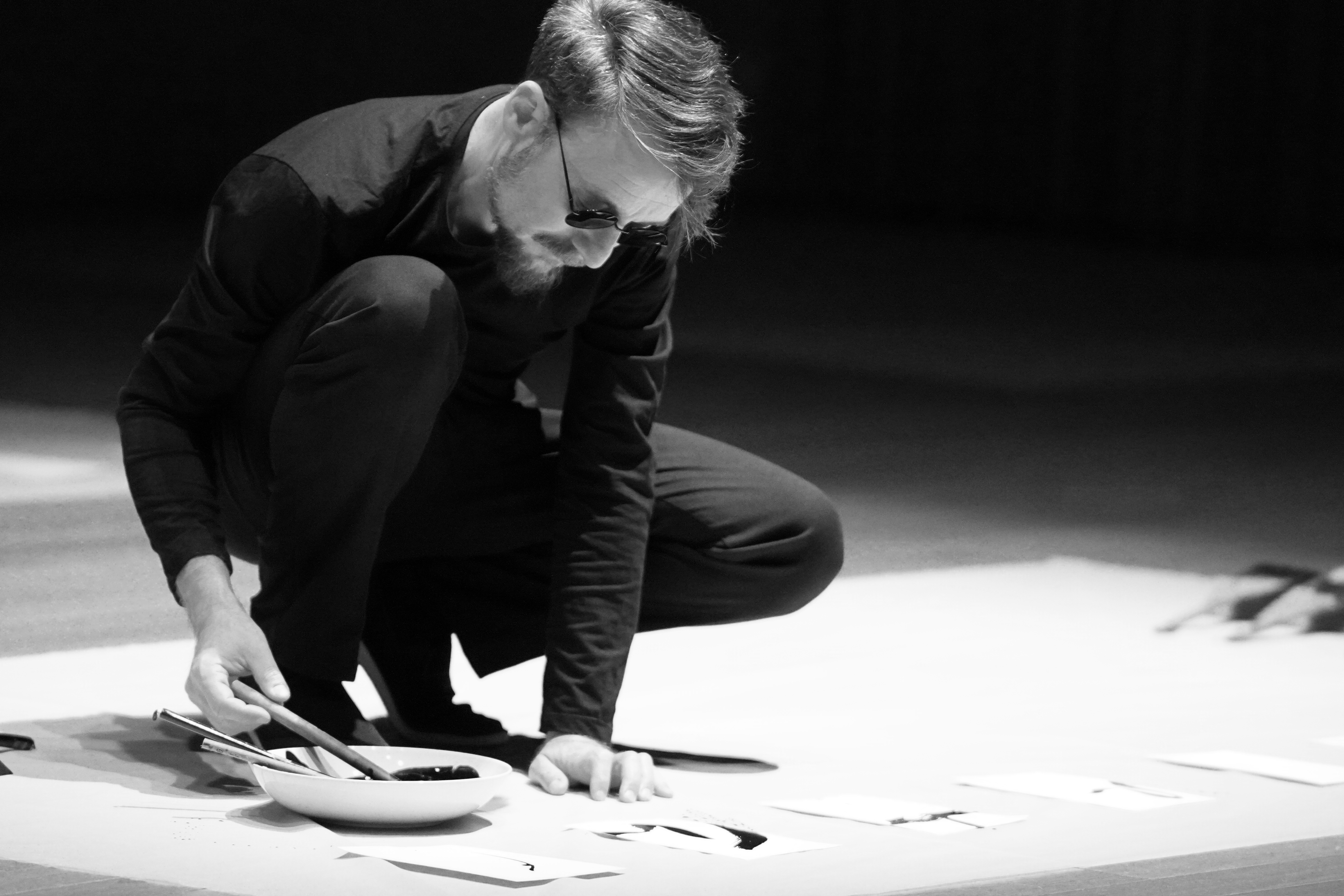
William-Josh Beck is a French visual and sound artist based in Brittany. His artistic background includes musical composition, photography and video, with ink on paper becoming central to his visual practice.
His training in Japanese ink and brush techniques with independent calligraphers in Japan contributed to the development of his approach to gesture and abstraction, informed in particular by the experimental traditions of post-war Japanese calligraphy.
His practice has progressively expanded into sculpture, installation, performance and experimental moving image, maintaining a close relationship between visual and sonic expression.
His work has been presented internationally, including at ZS Art Galerie (Vienna), Nishiaizu International Art Village (Fukushima), the Couvent des Cordeliers (Grandson) and the Fondation Écureuil pour l’Art Contemporain (Toulouse). He is represented by The Vanner Gallery (Salisbury) and Galerie de Nuage (New York / Hong Kong).
His training in Japanese ink and brush techniques with independent calligraphers in Japan contributed to the development of his approach to gesture and abstraction, informed in particular by the experimental traditions of post-war Japanese calligraphy.
His practice has progressively expanded into sculpture, installation, performance and experimental moving image, maintaining a close relationship between visual and sonic expression.
His work has been presented internationally, including at ZS Art Galerie (Vienna), Nishiaizu International Art Village (Fukushima), the Couvent des Cordeliers (Grandson) and the Fondation Écureuil pour l’Art Contemporain (Toulouse). He is represented by The Vanner Gallery (Salisbury) and Galerie de Nuage (New York / Hong Kong).
Statement
William-Josh Beck is a contemporary visual and sound artist. His research explores how time becomes perceptible through gesture, trace, and matter, and how paper, landscape, or space can be approached as surfaces of writing, bearing witness to the instant and to historical time.
Extending his practice with ink on paper, he develops, through photography, sound, sculptural installations, performance, and video, a body of work where the reduction of means is articulated with a direct expression of the dynamic forces of life and nature.
Closely linked to his practice of musical composition, his ink-on-paper abstraction proceeds through the transmission of sound energy in the brushstroke. In black and white the aim is not to paint what can be seen, but what is heard: to transcribe the sound flow—music, acoustic landscape—into pictorial material.
His compositions notably take the form of large polyptychs composed of modular paper panels. Within a geometric mesh that structures the pictorial space, the flow of the line crosses edges, lines, and limits, playing on the tension between the rigour of the format and the freedom of the gesture.
His photography explores the confrontation between the ephemeral and the immemorial: from the fleeting traces of elements to the slow temporalities of telluric forces that traverse the mineral. It is about capturing the inscription of movement within matter, the visible memory of time at work.
In his video practice, his ink-on-paper works become the sole visual source material, transformed through filming and experimental video processing. His electroacoustic compositions orient the rhythm of the editing and the metamorphoses of black and white, as the materiality of paper and ink merges with digital interference.
His sculptural installations, sometimes accompanied by soundscapes, extend his ink-on-paper work into three dimensions. They combine white surfaces, raw stones, gestural lines, and black volumes with elementary forms, deploying in space a tension between movement and stillness, solidity and fragility. The stone introduces another temporality, between ephemeral gesture and geological time.
Finally, William-Josh Beck exposes his creative process to the public through live painting performances, in collaboration with musicians for whom he composes, in a dynamic of free improvisation, or with his own live sound creation system. These performances reveal a relationship of synchronicity, of joint vibration, between musical and visual gesture, where sound and image take shape in a single impulse.
Extending his practice with ink on paper, he develops, through photography, sound, sculptural installations, performance, and video, a body of work where the reduction of means is articulated with a direct expression of the dynamic forces of life and nature.
Closely linked to his practice of musical composition, his ink-on-paper abstraction proceeds through the transmission of sound energy in the brushstroke. In black and white the aim is not to paint what can be seen, but what is heard: to transcribe the sound flow—music, acoustic landscape—into pictorial material.
His compositions notably take the form of large polyptychs composed of modular paper panels. Within a geometric mesh that structures the pictorial space, the flow of the line crosses edges, lines, and limits, playing on the tension between the rigour of the format and the freedom of the gesture.
His photography explores the confrontation between the ephemeral and the immemorial: from the fleeting traces of elements to the slow temporalities of telluric forces that traverse the mineral. It is about capturing the inscription of movement within matter, the visible memory of time at work.
In his video practice, his ink-on-paper works become the sole visual source material, transformed through filming and experimental video processing. His electroacoustic compositions orient the rhythm of the editing and the metamorphoses of black and white, as the materiality of paper and ink merges with digital interference.
His sculptural installations, sometimes accompanied by soundscapes, extend his ink-on-paper work into three dimensions. They combine white surfaces, raw stones, gestural lines, and black volumes with elementary forms, deploying in space a tension between movement and stillness, solidity and fragility. The stone introduces another temporality, between ephemeral gesture and geological time.
Finally, William-Josh Beck exposes his creative process to the public through live painting performances, in collaboration with musicians for whom he composes, in a dynamic of free improvisation, or with his own live sound creation system. These performances reveal a relationship of synchronicity, of joint vibration, between musical and visual gesture, where sound and image take shape in a single impulse.